That Fed Takeover of the DC Police? It’s Kind of Our Fault…
-first published in Substack blog “The “Last Editor” on August 20, 2025
I’ve been lucky to get to travel a lot, both for work and for pleasure. Much of that travel has been internationally, but the vast majority is right here in the United States. There’s nothing I enjoy more than landing in a city to which I’ve never been before, dropping my luggage at the hotel and setting out on foot or using public transit to explore. I often stay out well into the wee hours of the morning, discovering the city and its culture. I sometimes worry I won’t be able to get public transit back to my hotel, or that establishments will close before I’m able to get there. But I’m almost never worried I’ll be a victim of crime while out on my own on those unfamiliar American streets.
I admit there’s a certain level of privilege in that statement—I’m a white man and I know women and people of color will have a different experience than me. But what I’m focusing on here is not so much my or anyone else’s anecdotal experiences. I want to talk about the macro-level likelihood of encountering crime in American cities. The truth is, whether it’s Los Angeles, New York, Washington, DC or even my hometown of St. Louis—often considered the murder capital of the country—violent crime is less prevalent now than it has been in decades. On a national level, violent crime is down more than 50 percent between 1990 and 2023 (the lastest statistics available). Statista pulled them together into a line graph that makes the downward trend of crime very clear.
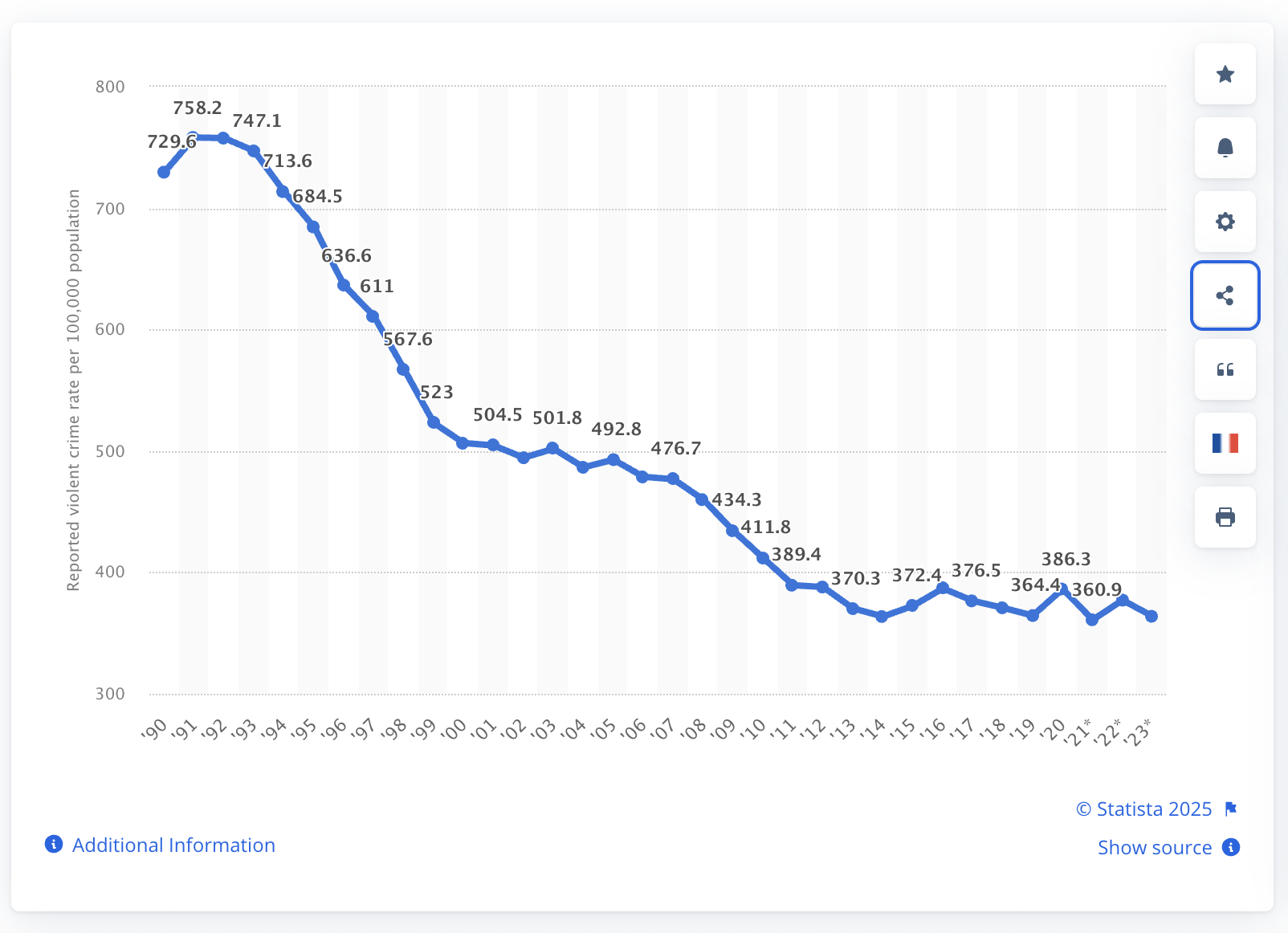
These are the national figures, but look at the violent crime numbers in any major city over the same time period and the trend is pretty much the same.
Discussing the reasons for this decline is beyond the scope of this writing, but suffice it to say there are a number of factors, from changes in policing to economic growth to removal of lead paint from homes.
So, with these facts laid out in black and white, how is the president able to claim that crime is growing out of control in Washington and that the federal government needs to take over the DC Police to get it in check? The reason is that much of the American public believes that crime is perpetually on the rise. Pew research from last year shows the trend in the 21st century.
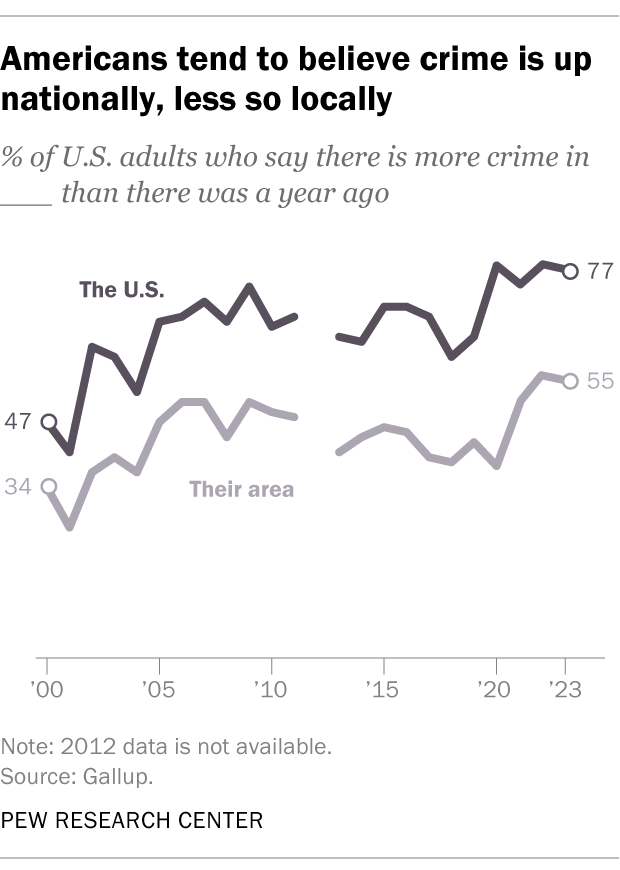
The graph of actual crime numbers and the graph of public perception of crime are moving in almost exactly opposite directions. That means as crime rates drop, the public’s perception is that crime is consistently on the rise—both nationally and where respondents live. How can this be? The answer, sadly, is our reporting.
This problem of the media overinflating crime is not new. I can remember sitting in the Missouri Theatre in Columbia in the fall of 2002 watching the Michael Moore documentary, Bowling for Columbine. In the middle of the film, Moore is walking in South Central Los Angeles beside sociologist Barry Glassner. They’re pondering why they haven’t immediately become the victims of crime, considering South Central’s notorious reputation. Glassner explains his research shows the media overplay crime and that media consumers believe crime is getting worse when it is really getting better. His solution was for journalists to pay less attention to the easy-to-cover crimes and more to things that really are threats to us—something I had been preaching in class for years. I ran out the next day and bought Glassner’s book, The Culture of Fear: Why Americans Are Afraid of the Wrong Things: Crime, Drugs, Minorities, Teen Moms, Killer Kids, Mutant Microbes, Plane Crashes, Road Rage, & So Much More. First published in 1999 (and with an updated edition in 2010), Glassner’s book ended up required reading in my broadcast and documentary reporting classes all the way until I retired in 2021. Despite first being published a quarter century ago, it’s still a vital read for anyone concerned about the crime stories we journalists produce.
Glassner’s position—and mine—is that the news media too often do crime stories because they’re easy. I used to explain it to my classes like this: newsrooms have a lot of newscasts to fill. And when a station adds a new newscast to its daily lineup, it usually hires a producer to do that show—but it doesn’t hire any more reporters to fill the extra newscast time each day. That means each reporter must produce more stories to fill more time. In-depth or investigative reporting done right takes time—a lot of time. But crime stories are quick and easy. There’s always a crime scene to get video, there’s always a witness or neighbor willing to go on camera and there’s always a cop or prosecutor to give that side of the story. A mediocre reporter can do three or four crime stories in a day, helping feed the beast of all those newscasts. So newsrooms doubled down on crime coverage in the 1990s (when newscasts were expanding) even though crime was dropping. As a result, the folks at home ended up seeing more and more crime stories on the news each night, so naturally they believed crime was going up.
Aside from taking the easy road with crime coverage, we fooled ourselves into thinking this was news. Most of the crime we’ve covered over the past three and a half decades has been drug-related crime (murders, armed robberies, thefts, home invasions, etc.) that only affects the people directly involved. Almost none of our viewers is ever affected by any of the crime they see on our air, but there’s still something about that sort of coverage that reaches into our brains and pokes a little spot that make us believe this is news that affects us. Even though the vast majority of viewers will never personally experience the sort of crime on which we’re constantly reporting, this little spot in their brains tells them this is news and that they should be afraid.
This focus on crime has led to a race for the bottom. Stations that cover more crime hang on to the viewers entranced by that coverage, but lose thinking viewers who can see there’s nothing left in the newscast for them. Around two decades ago, the exodus of viewers created an upside-down situation in which all stations lost viewers over their lack of relevant coverage, but the ones covering the most crime where able to hang onto the most viewers and come out on top of the ratings, winning a Pyrrhic victory at best.
Before you think I’m beating up on journalists too much, politicians have their fair share of blame for this growing fear of crime. Politicians on both sides of the aisle know that fear can be a motivating factor to get people to vote certain ways. The left has focused on more big picture fears, such as climate change and environmental problems. But the right has been better at using more immediate, personal fears to motivates its voters—fear of immigrants, fear of minorities, fear of rising costs and, of course, fear of (non-existent) rising crime. The current president is a master at this technique, having his followers believe our big cities are too dangerous for anyone to ever be able to visit. The number of suburban, white men who’ve proclaimed their fear of entering the central parts of incredibly safe cities like Atlanta or Seattle is downright laughable—as is a certain U.S. senator who proudly tells people he doesn’t wear his seatbelt when driving in Washington for fear of not being able to get out of his car fast enough when he’s car-jacked.
As this federal takeover of DC law enforcement plays out, there is some hope in sight. I’ve seen quite a bit of reporting on the actual crime numbers being down in DC and in other large cities. I’m hoping this will continue and that crime coverage focuses on incidents that affect a great number of people and that our reporting focuses on trends and the public policy efforts to reduce crime. I also hope we’ll take some resources freed up by not chasing every crime that comes over the scanner with reporting that focuses on the real threats to our viewers. I can recall doing just that back in 2003, when fear of child abductions seemed to be at an all-time high. KOMU-TV anchor Beth Malicki produced a series of stories about what dangers our children really face. While everyone was worried their children would be abducted, Beth’s reporting showed the chances a stranger would take your child are astronomically small. The real threat, she reported, is that your child will suffer from obesity or learning difficulties or other very real and far more likely problems. We need to so more stories like that to focus public attention on real problems with real solutions—and not some criminal bogeyman who’s never going to be lurking in your bushes.
It's likely Trump will send the National Guard to more and more big cities run by Democrats, a scheme that will continue to pay off unless we report crime with the context it deserves. I’m optimistic this has already begun and hope to see more of it as this ploy proliferates.