Tomorrow is Local News Day
-first published in Substack blog “The “Last Editor” on April 8, 2026
In the list of days you celebrate each year, Local News Day is probably not a high priority. In fact, you’ve probably never heard of it. I hadn’t until yesterday, when it popped up on something I was reading. More about the day and the good that can come from it in a moment, but first, let’s talk about local news.
Like many people reading this, I grew up in the suburbs of a good-sized city, St. Louis in my case. The 1960s and 1970s were a time of abundance for local news. In St. Louis we had two major daily newspapers (the still extant St. Louis Post Dispatch and the defunct St. Louis Globe-Democrat), three strong local TV newsrooms (and one small player—any St. Louisans remember Christine Buck at KPLR 11 News?), one of the most powerful all-news radio stations in the country (then CBS-owned KMOX-AM) and a network of local community newspapers covering different parts of the vast county surrounding St. Louis made up of 88 small municipalities. The local TV and radio stations, along with the two big papers did a great job of covering the significant issues affecting the city. But those local community papers made a daily difference in our lives. I remember the Baden News-Press when we lived in north St. Louis County and then the St. Charles Journal, the St. Charles Banner-News, the St. Charles Messenger-Tribune, the St. Peters Star Times and the O’Fallon Times once we moved to St. Charles County. That’s right, there were at least five very local newspapers covering the next county over from St. Louis, a county of about 120 thousand people. These community newspapers covered the goings-on of our local aldermen, important actions by local government and everything happening at our local schools. Proof of that is this clipping from the St. Charles Messenger-Tribune of me (I’m second from left with a lot of hair and a very 1977 shirt) and my brother taking honors in the math contest at a nearby high school:
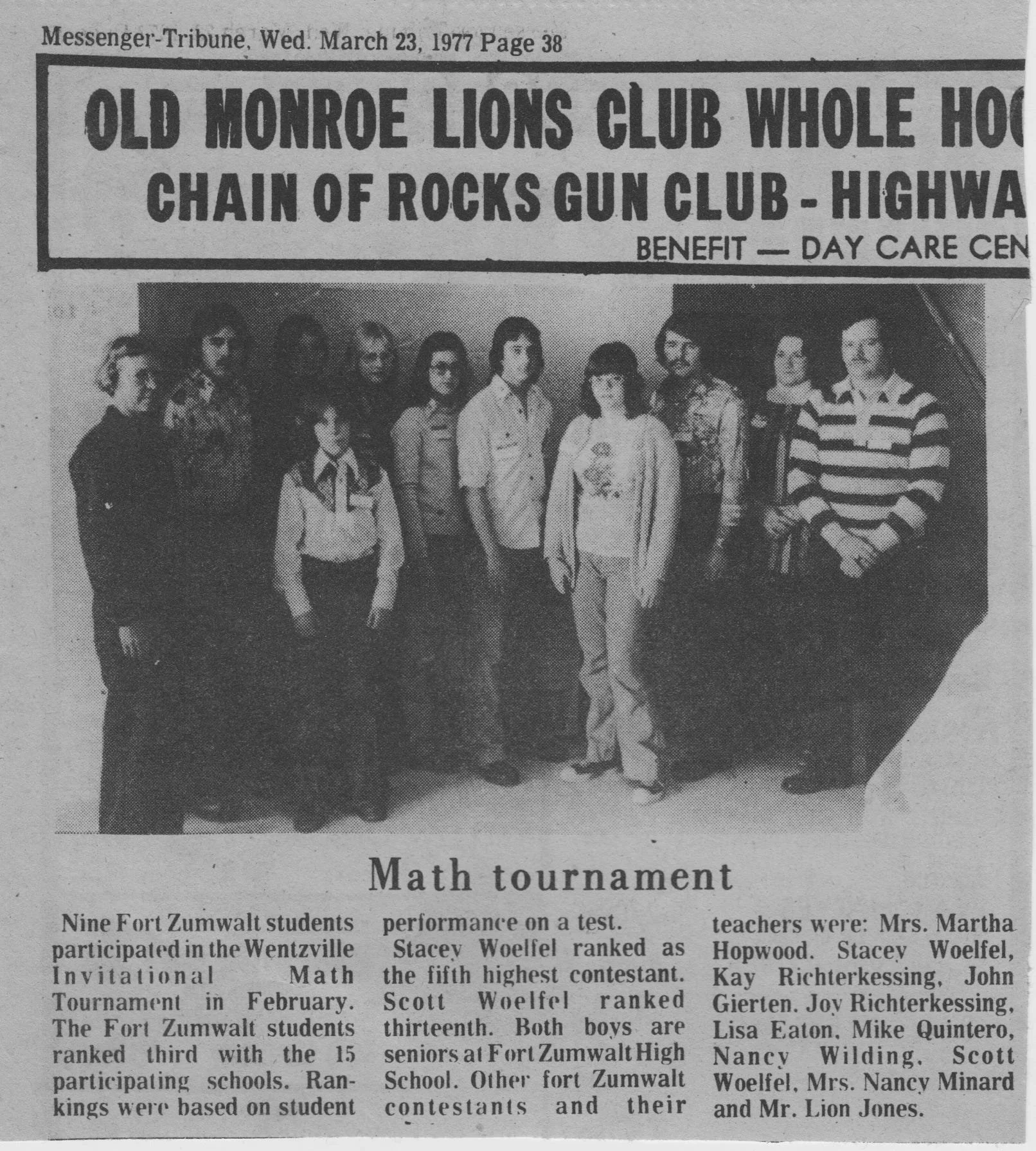
That photo is evidence of one of the best things about these newspapers—you could clip and save the articles in which you appeared. Thanks to that and other benefits, circulation numbers were high, advertisers craved access to the hyper-local audiences of these paper and it was still special to see your name in the paper for something you had accomplished. The business model for these papers worked 50 years ago. But it didn’t last forever. None of the four community papers I enjoyed as a teenager exists today.
What many use now for hyper-local coverage is a far cry from these community papers.
Online sources pushed out printed papers years ago in most cities. Sites like Patch and Nextdoor want to take the place of those old community newspapers, but fall far short. Patch has a few local journalists scattered across the country, but aggregates most of its content from legacy newspapers and TV stations near its cities. Nextdoor doesn’t employ any journalists and relies solely on aggregating stories from Patch and legacy media. But Nextdoor’s real crime is that its columns are filled with “reports” from Nextdoor users that many may view as news, but are merely observations and rants with no reporting or journalism. I subscribe to the local Nextdoor here in La Quinta—mainly to shake my head at what gets posted—and my feed is typically filled with reposts of stories from the local TV stations, restaurant “reviews” almost entirely focused on restaurants costing too much and racist posts with pictures of brown or black men caught on Ring cameras with the caption “Danger! Seen in the neighborhood!”
On the eve of Local News Day, it would be easy to be pessimistic about the state of the profession. Big legacy media are finding it hard to see a business model that can persist into the future. For-profit community publications have left most cities and suburbs with the Patch and Nextdoor carpetbaggers moving in to try to vacuum up some cash. Those are mighty blows to our profession. But a light at the end of the tunnel keeps me optimistic and should be your focus on Local News Day—nonprofit newsrooms. A search at FindYourNews.org shows 85 nonprofit newsrooms covering California—and the list doesn’t even include several local newsrooms here in the Coachella Valley.
I get great local news from the Palm Springs Post, the Coachella Valley Independent and the Indio Post. All have professional journalists covering important local stories that often fall under the radar of the local TV stations and the lone for-profit English language newspaper in the area, Gannett’s Desert Sun in Palm Springs. Not community focused, of course, but the other nonprofit news organization on which I rely daily is the Sacramento-based CalMatters.org, one of the best statewide nonprofit newsrooms in the country. I support these essential nonprofit newsrooms with subscriptions and donations, contributing as I am able to keep these newsrooms covering my community in a way we haven’t seen in 50 years.
As Local News Day arrives, I challenge everyone reading this to find a nonprofit newsroom that serves your community.
The Local News Day web site has a newsroom locator page that can be a start (it’s a bit clunky, so it may take some effort to get it to work for you). The aforementioned FindYourNews.org is another place to search. Even a simple Google search will produce some options to check out. Once you have a list of the nonprofit newsrooms serving your area, make an account at each of them, log in and check out the content. If it looks like you’re seeing solid journalism in service of your community, take one more step and buy a paid subscription or make a donation to as many of them as you can afford. Being nonprofit doesn’t mean the stories these newsrooms publish are free to produce. Good reporting costs money and at least some of that money has to come from a nonprofit newsroom’s consumers. Being community supported keeps these journalism organizations free from advertiser or big owner influence, keeping them as close to pure as journalism can be.
I’ve got a pretty good handle on the nonprofit newsrooms in my area and how I can support them. So while you’re finding some new newsrooms to support on Local News Day, I’ll be checking out a live stream coming out of the founding newsroom of Local News Day, the Montana Free Press. Though the event’s focus is local (or course), you should check it out if for no other reason than to hear from John S. Adams, the founder of Local News Day and one of the most important investigative and political reporters working in journalism today. I’ll also be reading and interacting with the nonprofit newsrooms I already support, hoping this Substack post and my continued interest will help buoy them and move them further toward success for themselves and the communities they serve.